
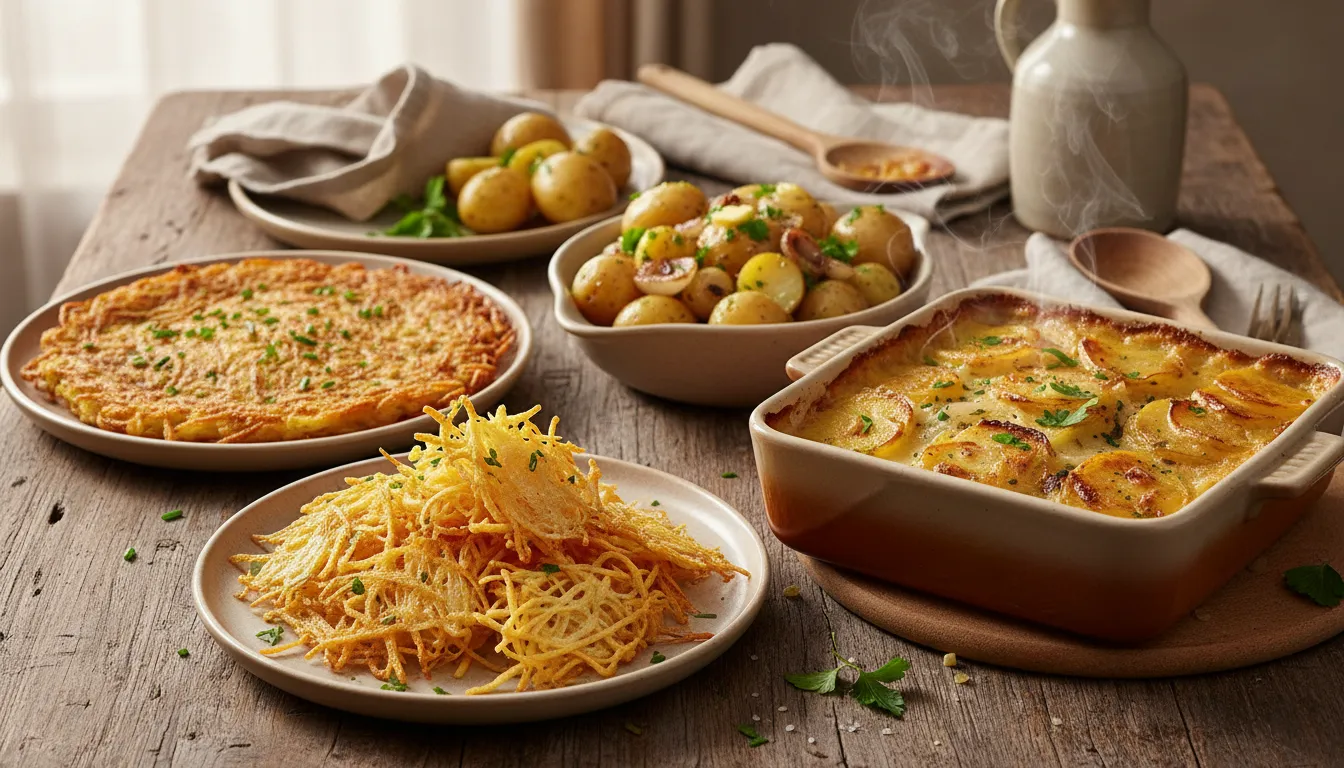
For me, a meal is not a meal without a great potato dish. Strip the table of its pommes Maxim, its pommes boulangère, its buttered new potatoes, its rösti, and something is missing. The plate may be handsome enough, but the meal itself feels underdressed. Naked, even.
That is the beauty of the potato. Humble, inexpensive, endlessly adaptable, and capable of extraordinary things if you treat it correctly. In the right hands, it can be crisp and lacy, soft and intoxicating, rich with butter, fragrant with onion, or as comforting as the perfect chip.
These four classic potato dishes all come from that same philosophy. They are not built on complexity. They are built on care. A little understanding of starch, moisture, heat, seasoning, and patience is what separates a proper potato dish from a mediocre one.
And that is really the point. Expensive ingredients are often praised as luxuries. Truffles, caviar, saffron, all the usual suspects. But the most expensive ingredient of all is your time. Spend it properly on potatoes and they will reward you magnificently.
Table of Contents
- The first rule of cooking potatoes well
- Pommes Maxim: the great classic of butter and potatoes
- Pommes Boulangère: potatoes, onions, stock, and the genius of simplicity
- Potato rösti: crisp outside, soft center, no nonsense
- Twice-cooked chips finished with butter
- What these Michelin potato dishes really teach
- Practical tips for better potato cooking at home
- A final thought on potatoes and pleasure
- FAQ
The first rule of cooking potatoes well
Before getting into the dishes themselves, there are a few principles that run through everything.
Do not wash sliced potatoes unless the dish specifically requires it. In dishes like pommes Maxim, pommes boulangère, and rösti, the starch is essential. It is the cement that binds the layers together.
Dry the slices on a cloth. You want to remove excess surface moisture, not the starch.
Butter often comes before seasoning. If you season the potatoes too early, the salt will begin pulling out water. Butter helps protect them.
Heat must be controlled. You are usually trying to caramelize gently, not scorch.
Use your hands. Feel the food. Understand its texture. That physical connection teaches you more than measuring everything at arm’s length.
And one more thing. If you are using a mandoline, keep your fingers and especially your thumbs out of the way. Use the palm of your hand and respect the blade. A mandoline has a very efficient way of eating the careless.
Pommes Maxim: the great classic of butter and potatoes
Pommes Maxim is one of those dishes that proves how far two ingredients can go. Butter and potatoes. That is essentially it. Yet done correctly, it looks elegant enough for a fine dining table and tastes far grander than the shopping list suggests.
The principle is simple. Thin slices of potato are layered in a pan in overlapping circles, glazed with butter, seasoned at the right moment, then gently caramelized until golden and crisp outside while the interior becomes tender and cohesive.
How to build it
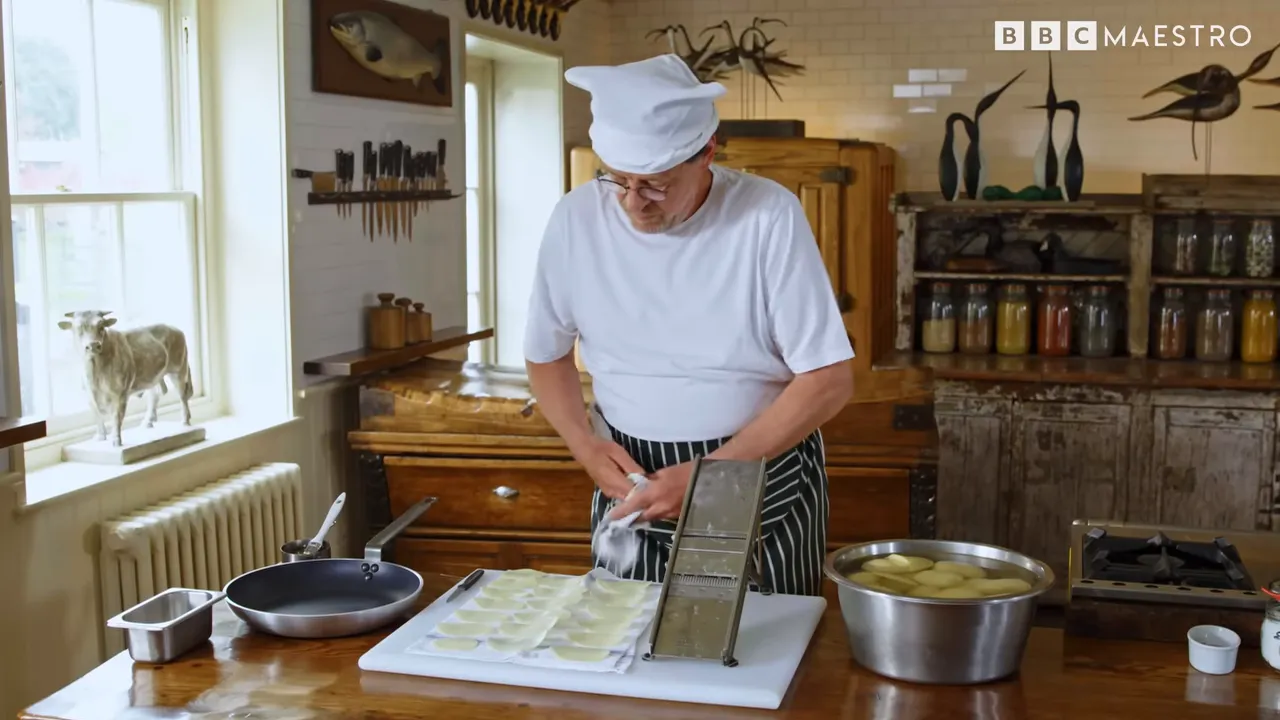
The potatoes should be sliced very thinly, about 2 mm. A floury potato such as Golden Wonder works beautifully here. Try to use potatoes of similar size and shape, because if they match naturally, you do not need to punch them out with a cutter or trim them into uniform rounds. Less waste, more honesty.
Once sliced, lay the potatoes on a cloth and dry them. Again, do not wash them. You need the starch to help the whole thing hold together as it cooks.
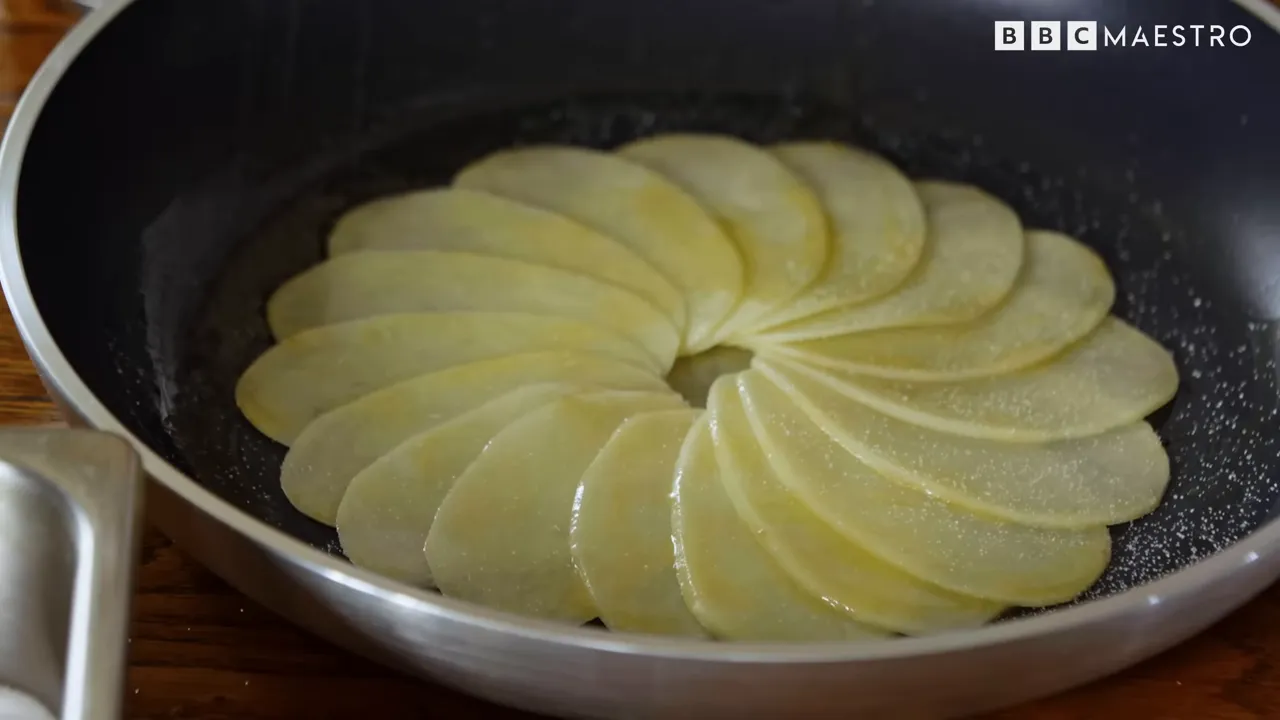
Then arrange the slices in the pan like a giant daisy. One ring overlapping the next, preserving the natural order of the slices as much as possible rather than mixing them all together. There is a quiet discipline to this kind of construction. It matters.
Once the first layer is down, brush or spoon over a little butter, then season. Butter first, seasoning second. Remember that. If the salt goes onto bare sliced potatoes, it starts drawing out water and makes the structure slacker.
Repeat the process with further layers, always drying the slices, always buttering before seasoning, building a compact round of potatoes that is neat, even, and properly formed.
The cooking is gentle, not aggressive
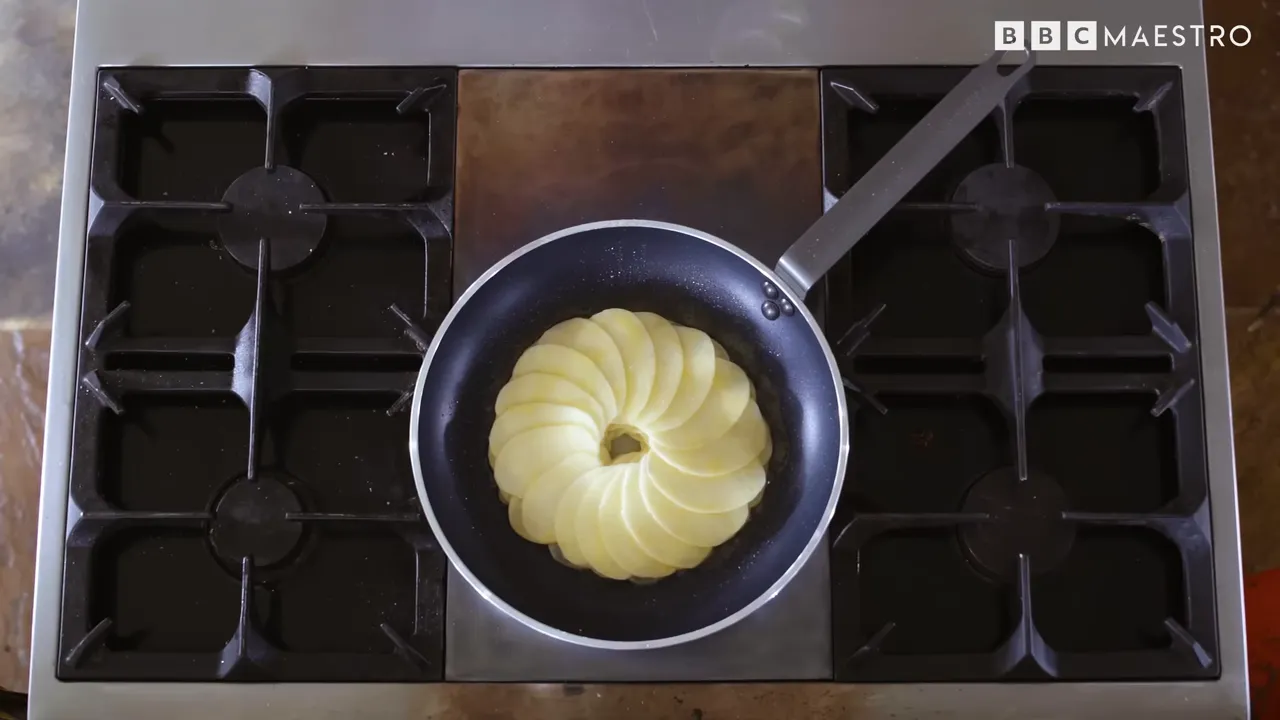
Set the pan over the heat and bring that heat in slowly. This is not about slamming the pan over a fierce flame and hoping for the best. It is about encouraging the clarified butter to work with the potato, creating a beautifully caramelized exterior and that nutty richness which makes the dish so seductive.
If your stove runs hot, begin at medium to high just long enough to bring heat into the pan, then reduce to low or medium. Once the pan contains the heat, you are only maintaining it. Push too hard and you scorch instead of caramelize.
This stage is part skill, part instinct. You can see the outside beginning to turn golden, but the middle remains something of a guessing game. That is one of the realities of kitchen work. Not every test is visual. Sometimes you use smell, sound, resistance, experience.
There is also a lovely old kitchen truth here. In professional kitchens, the solid top stove used to be called the piano. The hottest point was in the center, and the heat faded as you moved outward. You learned to play it, sliding pans from one zone to another, controlling temperature by position as much as by flame. Great cooks know how to manage that dance.
How to flip a pommes Maxim without ruining it
Before turning the potato, remove roughly 90 percent of the butter from the pan. Then lightly butter a tray or plate. This sounds like a small thing, but it is one of those details that saves the shape of the dish.
Invert the pommes Maxim onto the buttered tray, then slide it back into the pan. Because the tray is buttered, it slips rather than sticks. No tearing. No distortion. No heartbreak.
Return the removed butter to the pan and continue cooking gently.
To test doneness, push a knife into the center after a few minutes. If there is resistance, give it a little longer. If the resistance decreases, you are getting close. When the knife slides through the layers with no resistance at all, it is ready.
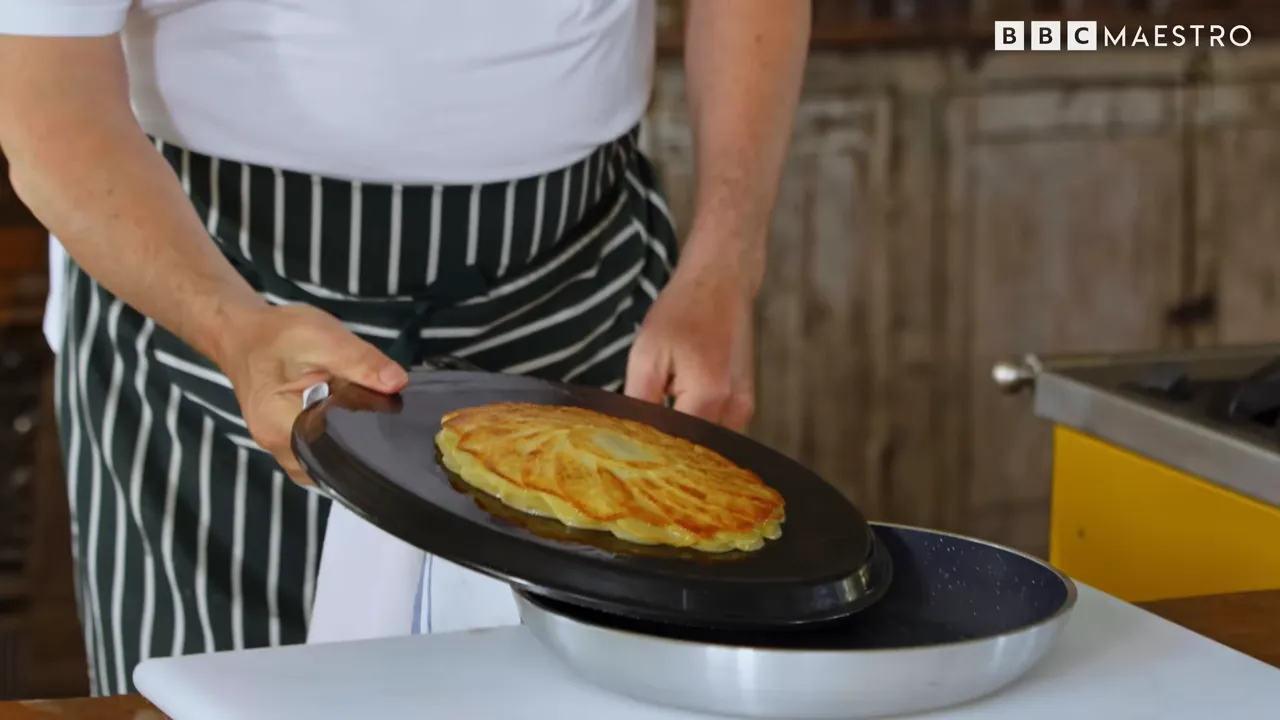
How to serve it
Finish with a little crystal salt. At this point, the dish is already glorious as a side, but it can easily become the center of a meal.
For a generous main course for two:
Cook four eggs
Slide them on top
Add crispy fried onions
Scatter over slivers of hard vegetarian cheese
Pass it under the grill for 30 seconds
Serve with a little salad
Cut it in half and you have something rich, crisp, comforting, and complete. Proof that potatoes can carry a table on their own shoulders.
Pommes Boulangère: potatoes, onions, stock, and the genius of simplicity
If pommes Maxim is about crispness and buttery architecture, pommes boulangère is about absorption. It is one of the most comforting potato dishes ever invented.
The name tells a story. On Sunday mornings in France, families would prepare their potatoes at home, then take them to the baker before church. The dish would cook slowly in the bread oven while they were away. On the way home, they would collect it and serve it for lunch, often with roast lamb and its juices. It is easy to understand why this sort of food defines a culture. It is practical, economical, and utterly delicious.
At its heart, this dish is sliced potatoes, onions, butter, and stock. But each of those elements must be handled correctly.
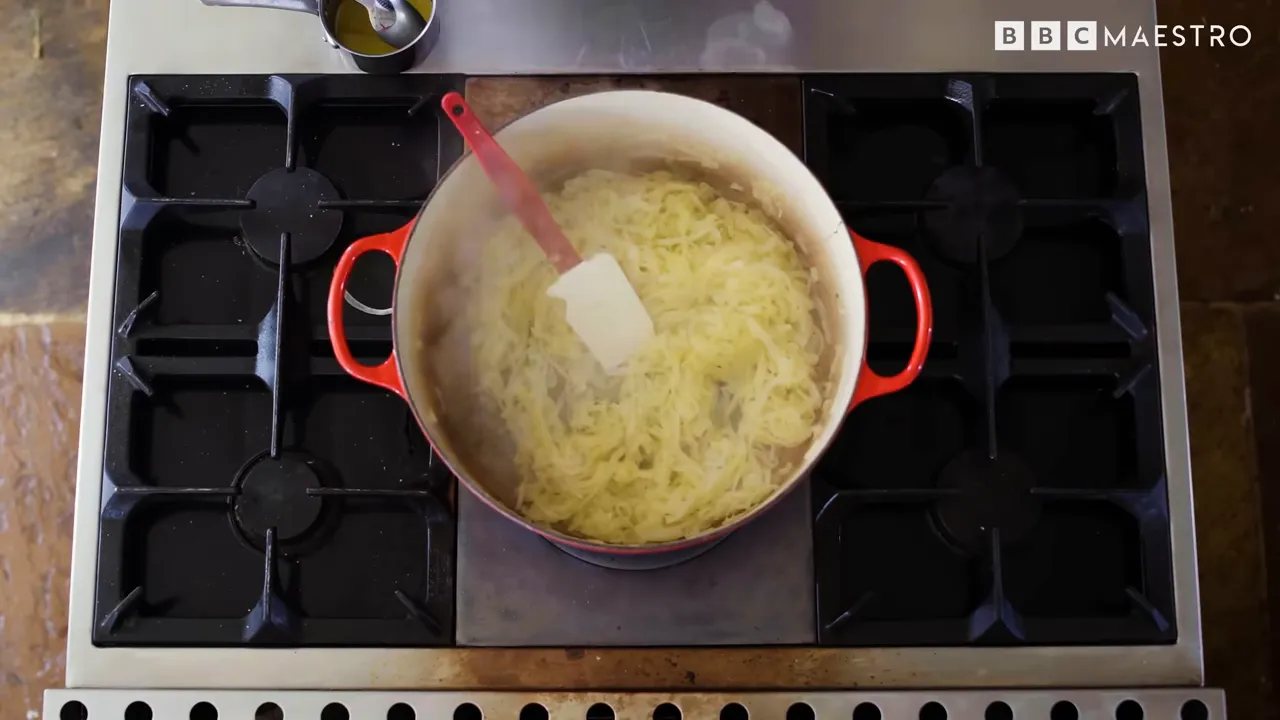
Start with the onions
The onions are gently cooked in butter with seasoning until their water content is nearly gone and their natural sweetness emerges. At first onions smell sharp and acidic. Then that smell changes. It softens. Sweetens. That shift tells you a great deal about what is happening in the pan.
Once softened, the onions are drained. You can use a colander, but many chefs simply tip them onto a tray and tilt it so the excess butter runs away. Efficient, direct, no fuss.
Then the potatoes
The potatoes are sliced thinly and laid on a cloth to dry. Once again, you are removing excess water while keeping the starch intact. Whatever you do, do not wash them.
Layer the potatoes into a lightly buttered dish. Add a little light vegetable stock, then season. The stock should not be too strong. You want to taste onions and potatoes, not be bludgeoned by an over-reduced broth. This is especially important with vegetable stock, which can become over-sweet and dominate the dish if you are not careful.
After the first potato layers, distribute the cooked onions evenly. Construction matters here. The ratio of potato to onion matters. The amount of stock matters. If the structure is wrong, the final presentation will never truly be right.
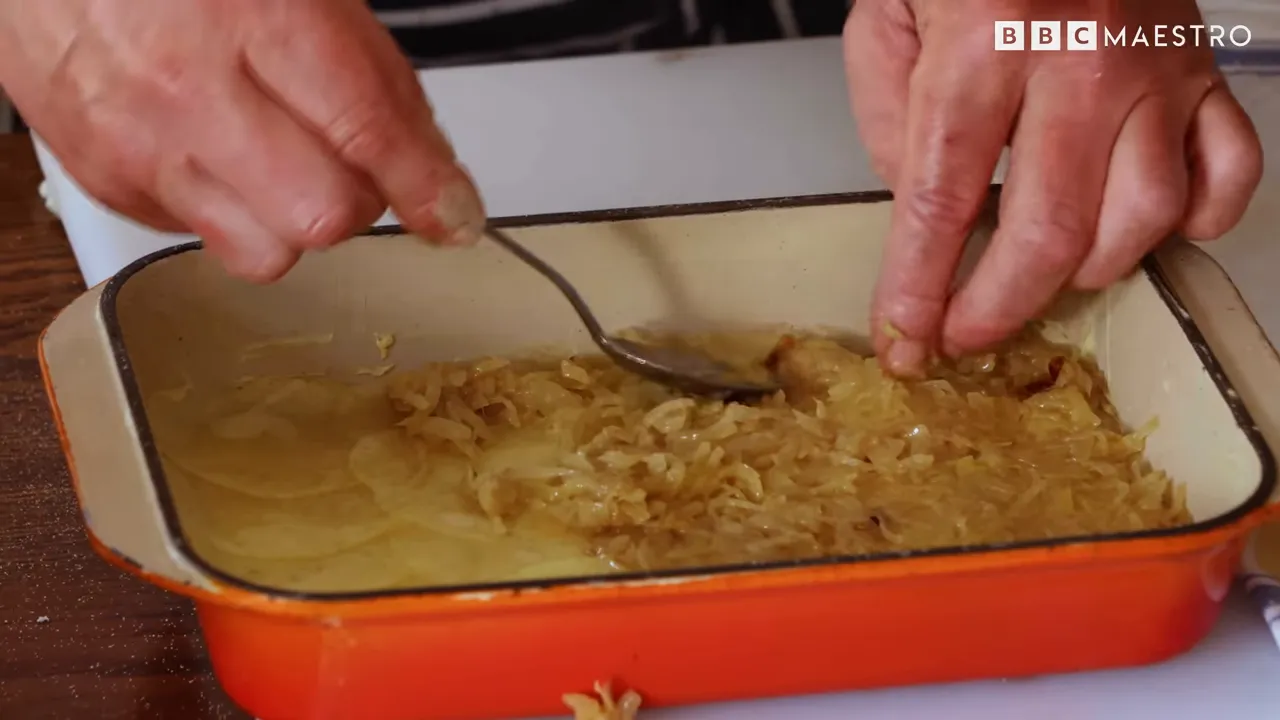
Build it like fish scales
Continue layering the potatoes in overlapping patterns, almost like fish scales, adding stock before seasoning and pressing lightly so everything settles together. You will notice the potatoes already beginning to drink the stock as you work.
Add more onions, evenly distributed. Be generous if you like onions. Let your palate dictate. The important thing is balance and consistency across the whole dish.
Then continue the process all over again until you reach the top. Finish with the last layer of potatoes, paint over any remaining butter for flavor, add a little more stock, and press down lightly.
Butter a sheet of foil and cover the dish. Bringing the dish briefly onto the stove before it goes into the oven is not absolutely necessary, but it helps speed the cooking in a more professional setting by getting heat into it early.
Low oven, patient cooking
Bake at 120°C for 1 hour 20 minutes. Slow, steady, and kind.
When it comes out, the stock should have been absorbed by the potatoes. That is one of the pleasures of the dish. The potatoes do not merely sit in liquid. They take it in. Butter, stock, onion, all drawn into the layers.
Finish with a little crystal salt and, importantly, let it rest. Resting allows the potatoes to complete their work, to absorb and settle and become more harmonious. They turn soft but still textured, full of stock, butter, and onion.
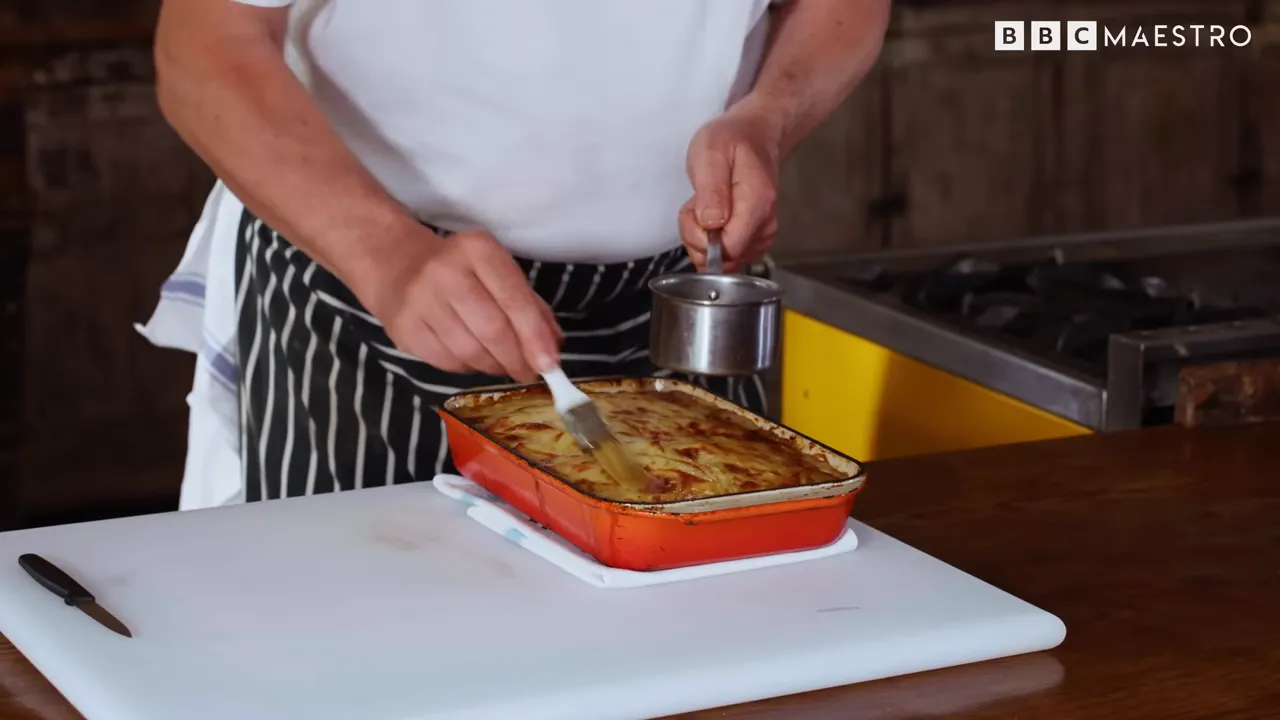
This is the sort of dish that is magnificent with meat or fish, but it also stands comfortably on its own. A splash of olive oil and a little salad alongside it, and lunch is sorted.
Potato rösti: crisp outside, soft center, no nonsense
Rösti is one of those dishes that should appear far more often than it does. It is straightforward, deeply satisfying, and perfect as a side dish or as a base for other things.
The version here is made from sliced potatoes rather than a wet, shredded hash brown style mixture. The slices are dried, coated in butter, seasoned, compacted, and fried slowly in clarified butter until crisp and golden.
Build the mixture
Slice the potatoes thinly, lengthways rather than across. Why lengthways? Sometimes there is no grand theory. Sometimes it is simply how one has always done it.
Lay the sliced potatoes on a cloth and dry them carefully, removing excess surface moisture. Put them into a bowl, add butter, and work the butter through so the slices are evenly coated. Season while the potatoes are moving. If you stop and dump the seasoning in one place, they will clump.
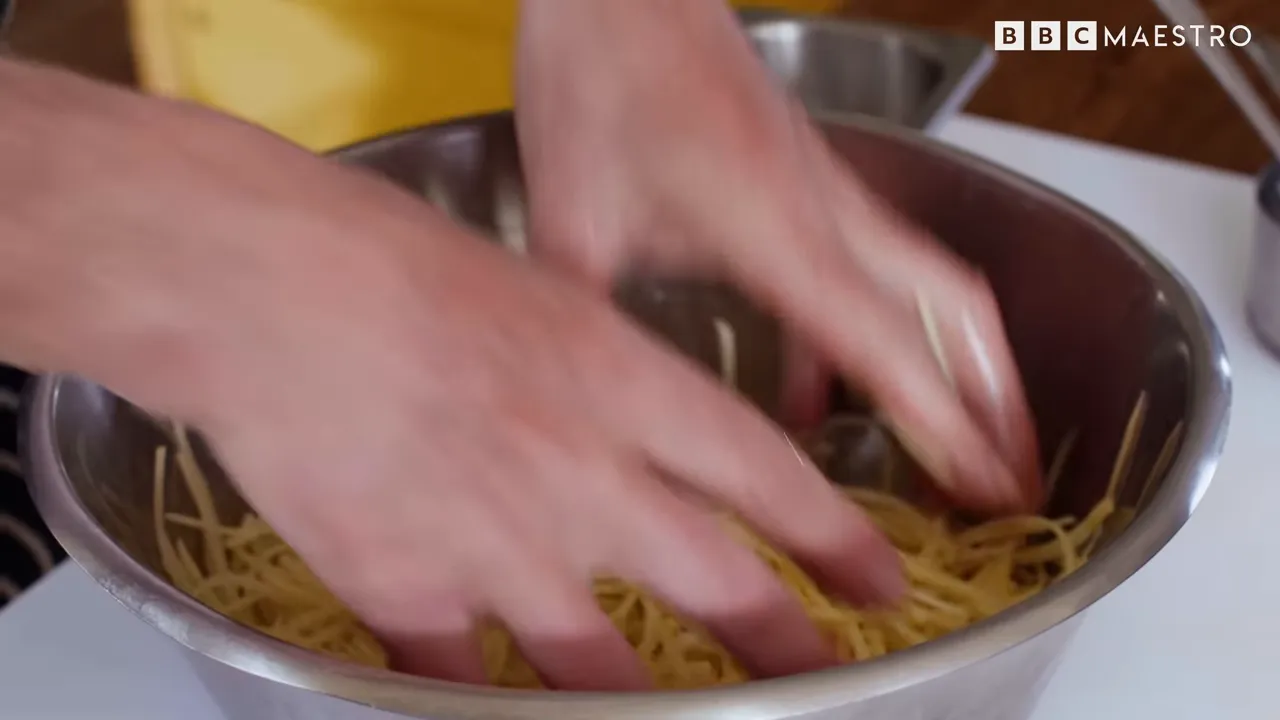
Butter the pan lightly, add the potatoes, spread them evenly, and work them into shape. Then compact them down gently so the rösti holds together.
Listen to the pan
Set the pan over the heat and let it come in slowly. You are after gentle caramelization, built gradually. Rush it and you will scorch the outside before the interior is right.
If you listen carefully, the pan begins to sing. That sound is the heat drawing water from the potatoes. And before a potato can truly caramelize, that internal water has to leave. That is an important little lesson in frying. Crispness is not magic. It is moisture management.
As the rösti cooks, keep shaping it, nudging the edges back into place, rotating the pan if needed, and allowing the stove to do most of the work. No need to bully it.
Flip it cleanly
Exactly as with pommes Maxim, lightly oil or butter a tray so that once the rösti is turned out, it slides neatly back into the pan. This preserves the shape and keeps your confidence intact.
Add a little more butter, continue cooking, and finish when the outside is richly golden and crisp.
If you do not have clarified butter, ghee is an excellent substitute. The key point is that butter contributes not only fat, but flavor. Potatoes absorb a percentage of it, and that is what makes a proper rösti so much more delicious than one fried in plain oil alone.
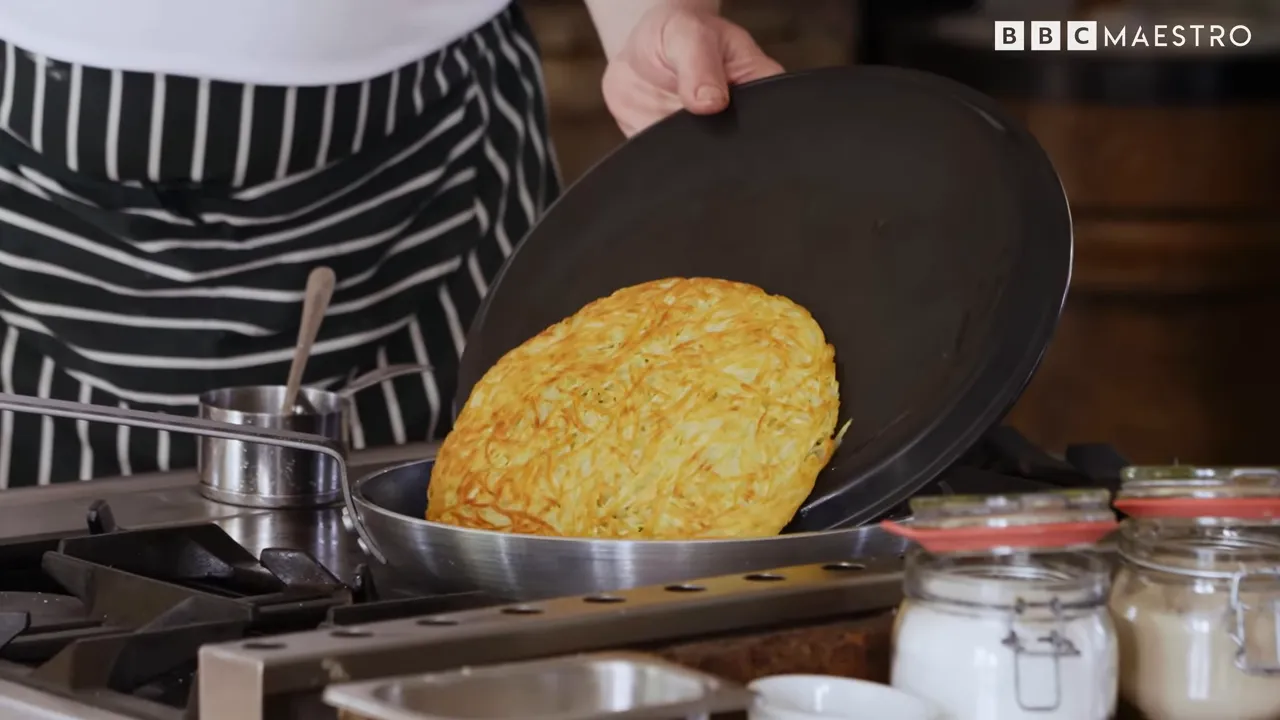
Ways to serve rösti
Serve it simply with crystal salt, crushed between your fingers. The aroma at that moment, earthy potato, sea salt, and butter, is sensational.
It also makes a wonderful base. A variation made with finely sliced dried onions and chopped parsley folded through the buttered potatoes becomes something close to a latke. Top it with eggs, season with crystal salt and mignonette pepper, and it is hard to imagine anyone complaining.
But even on its own, cooked to perfection, rösti is a splendid side dish for any dining table.
Twice-cooked chips finished with butter
Sometimes you want pommes Maxim. Sometimes you want rösti. Sometimes you want boulangère. And sometimes, honestly, you just want a chip.
A good chip takes some beating.
The version here is not triple-cooked. It is simpler than that. Just twice-cooked. Blanched first, then fried at a higher temperature to crisp and color. The little twist comes right at the end.
Cut, wash, and blanch
Cut the potatoes into chips of your preferred thickness. Not too thick, not too thin. Everyone has their own ideal. The important thing is consistency, so they cook evenly.
Unlike the previous dishes, chips are washed. This time you want to remove the starch. So after cutting, give them a good wash in water and drain them.
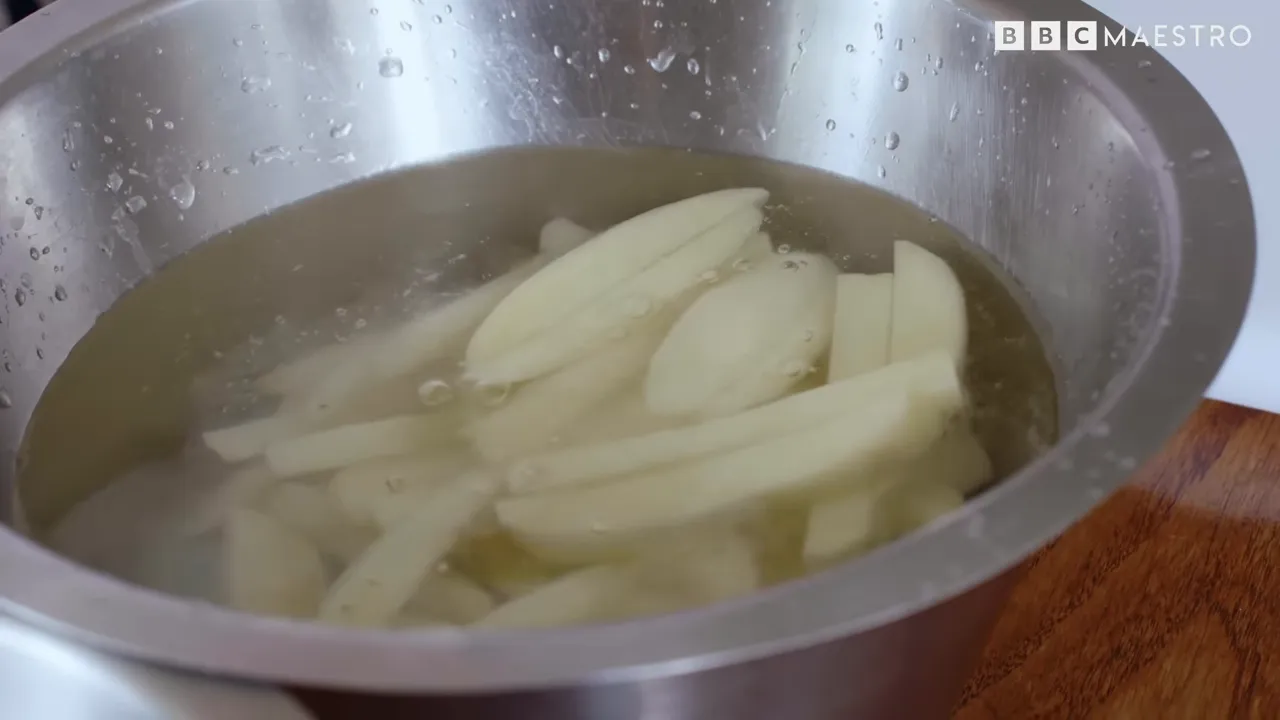
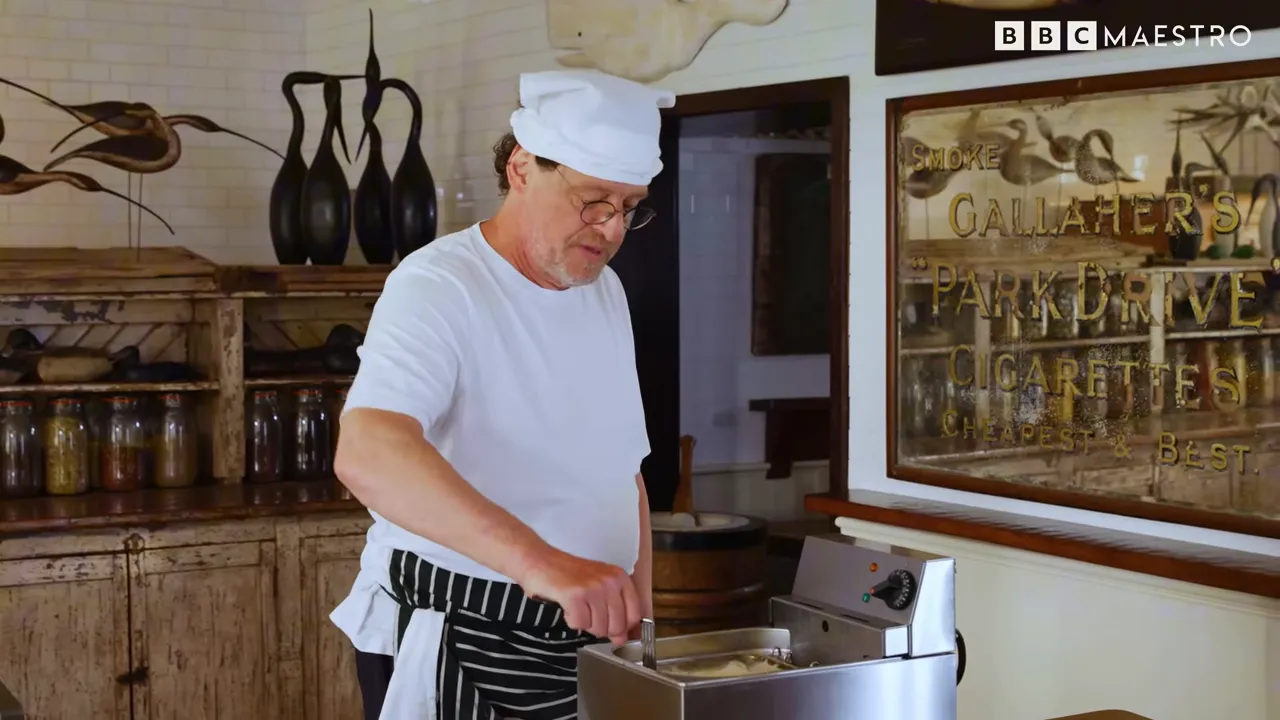
The first fry is really a blanch. Cook them at 140°C for about 8 minutes, until they are cooked through without taking on color. You can test them by touch. They should dent gently. That means they are ready.
Bear in mind they continue cooking in their own heat after they come out, so timing is always linked to thickness and feel rather than blind obedience to a number.
Finish at a higher temperature
Raise the oil to 180°C and fry the chips again. This second cooking is what creates the crisp exterior and that light tinge of color.
Once crisp, drain them and season.
The indulgent finish
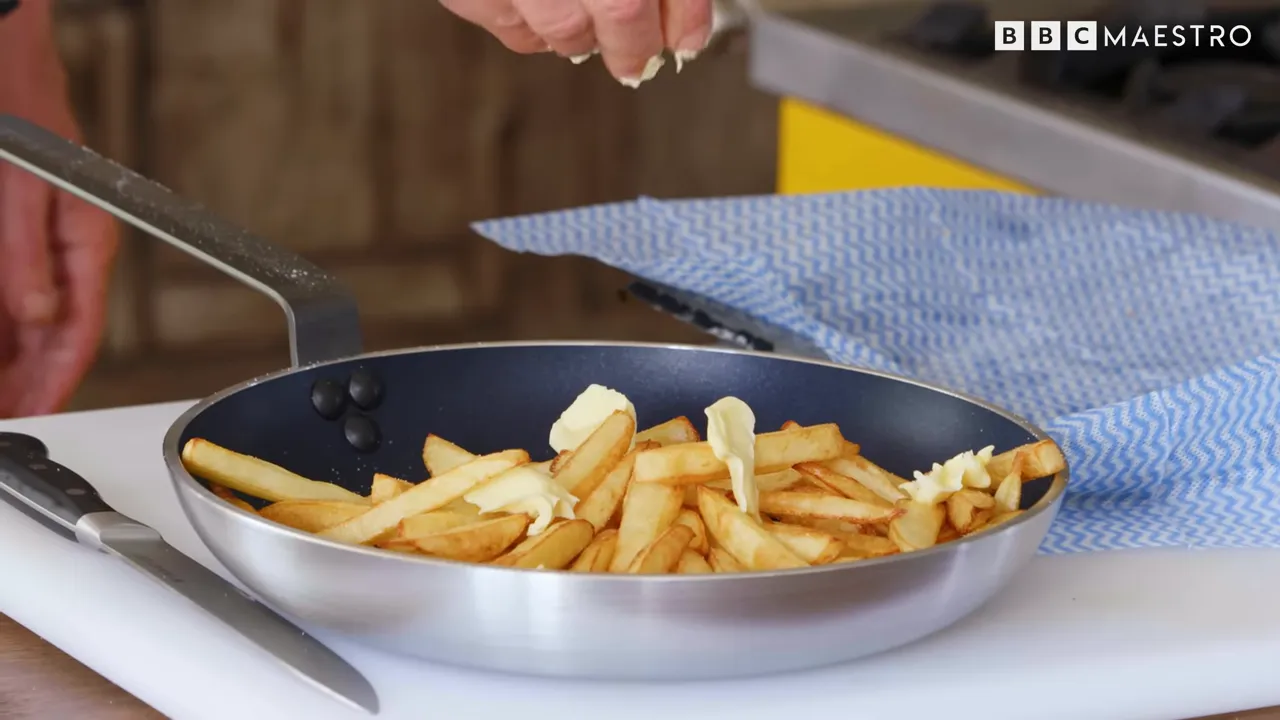
Now for the flourish that some will love and others will argue about. Toss the chips with a little butter.
This softens the brittle, overly dry crispness and gives them a richness that feels unmistakably French. Buttered chips are indulgent, yes, but magnificently so. A small amount is enough to change the whole personality of the dish.
If you have spent years around French cooking, this kind of instinct makes perfect sense. Why stop at crisp when you can have crisp and buttery?
What these Michelin potato dishes really teach
On the surface, these are four potato recipes. But underneath them sits a larger philosophy about cooking.
1. Respect the ingredient
The potato is not secondary. It is not filler. Treat it with the same seriousness you would give a piece of fish or a cut of meat, and it will return the favor.
2. Understand moisture and starch
This is the thread that runs through almost every one of these dishes.
For pommes Maxim, boulangère, and rösti, keep the starch.
Dry the slices so the structure holds.
For chips, wash the starch away.
Control water if you want crispness and cohesion.
3. Butter is not just fat
Butter gives richness, aroma, and color, but it also plays a technical role. It protects sliced potatoes before seasoning. It helps caramelization. It carries flavor. And, frankly, it makes things taste delicious.
4. Construction matters
The shape of the dish, the layering, the evenness of seasoning, the distribution of onions, the pressure used to compact a potato cake, all of it matters. Presentation at the end begins with construction at the beginning.
5. Time is the real luxury
You cannot rush proper potato cookery. Slow caramelization, careful layering, resting after baking, gentle frying, all of these ask for time. But that is exactly why the results are so satisfying.
Food rewards attention. Spend time with it and it teaches you.
Practical tips for better potato cooking at home
If you want these dishes to come out better immediately, keep these points in mind:
Use similarly sized potatoes for even slicing and cleaner construction.
Slice consistently, ideally around 2 mm for layered dishes.
Use clarified butter or ghee when frying for cleaner caramelization.
Season from a slight height so the salt falls more evenly.
Test doneness with a knife in layered dishes. Resistance tells you everything.
Let baked potato dishes rest before serving so the flavors settle and the texture improves.
Do not fear using your hands. Touch helps you judge moisture, compactness, and distribution.
A final thought on potatoes and pleasure
There is something wonderfully democratic about all this. Potatoes are not rare. They are not exclusive. Yet with a bit of discipline, they can sit proudly in the world of Michelin classics.
Pommes Maxim gives you elegance from almost nothing. Pommes boulangère turns stock, onion, and potato into something deeply soulful. Rösti delivers crispness and comfort in equal measure. And chips, especially with that final gloss of butter, remind you that simple pleasures can still be luxurious.
That is why great potato dishes matter. They bring texture to the table, warmth to the meal, and satisfaction that often outshines far more expensive ingredients.
Without them, the table really is naked.
FAQ
Why should sliced potatoes sometimes not be washed?
For dishes like pommes Maxim, pommes boulangère, and rösti, the starch on the surface of the sliced potatoes helps bind the layers together. Washing removes that starch, which makes the dish less cohesive.
Why is butter added before seasoning in some potato dishes?
Adding butter first helps protect the potatoes. If salt hits the bare slices too early, it starts drawing out water. That extra moisture can interfere with texture and structure.
What is the best potato thickness for pommes Maxim?
A slice around 2 mm thick works well. Thin enough to layer and cook evenly, but not so thin that the potatoes lose all substance.
Can I use regular butter instead of clarified butter?
Yes, but clarified butter is better for frying because it handles heat more cleanly and helps with even caramelization. If you do not have clarified butter, ghee is a good substitute.
Why is the stock kept light in pommes boulangère?
The stock should support the onions and potatoes, not dominate them. If the stock is too strong, especially a vegetable stock that leans sweet, it can overwhelm the natural flavor of the dish.
How do I know when a layered potato dish is cooked?
Use a knife. Insert it gently into the center. If there is resistance, it needs more time. When the knife slides through the layers with little or no resistance, it is cooked.
Why are chips washed while other potato dishes are not?
With chips, washing removes excess starch and helps create a cleaner, crisper finish. In layered dishes or rösti, that starch is useful because it helps the potato slices hold together.
What is the difference between blanching and finishing chips?
The first cook, or blanch, happens at a lower temperature and cooks the chip through without color. The second cook happens at a higher temperature and creates the crisp exterior and light golden finish.
Is it really worth finishing chips with butter?
If you enjoy a richer, more indulgent chip, absolutely. A little butter changes the texture and flavor, making the chips less aggressively crisp and more luxurious.